tsim: Modular Multi-Domain Defense Simulation Platform
tsim is a high-performance, modular simulation suite built in C++20 to bridge the gap between military protocol interoperability, sensor kinematics, physical-layer RF signal environments, and orbital mechanics. Rather than relying on monolithic, opaque simulation frameworks, tsim is structured as a decoupled ecosystem of high-throughput libraries and companion services designed for composition.
Foundational Graphics & Compute Engine:
tsim’s entire visualization and real-time GPU compute layer is built directly on WGFX: Modern WebGPU & C++20 Graphics Engine. WGFX manages the underlying Google Dawn device contexts, compute shader dispatches, reactive frame scheduling, and Dear ImGui / ImPlot harnesses acrossiqgen,waterfall,satviz, andantenna.
Multi-Domain System Architecture
graph TD
    subgraph TruthLayer ["Ground Truth & Physical World"]
        TRUTH["Simulation Truth
Entities, Waypoints & Kinematic Movers"]
    end

    subgraph SimulationServices ["Distributed Simulation & Propagation Services"]
        TRK["backend + tracktor
Kinematic Radar, AESA,
EO/IR & Passive RF Sensors"]
        SAT["satviz
SGP4/SDP4 Orbital Mechanics
& Constellation Shells"]
    end

    subgraph SignalAndFusion ["Signal Synthesis & Fusion Engines"]
        FUSE["trackfuse
Passive Bearing Triangulation
& Multi-Sensor Fusion"]
        IQ["iqgen + antenna
Real-Time WebGPU RF Signals
& Phased Array Multi-Beams"]
        GRAY["grayscale
Radiometric EO/IR Image Sensors
& Synthetic Video"]
    end

    subgraph VisualizationLayer ["Operator Displays & Analysis"]
        TVIEW["tview
Tactical 2D/3D Map
& Common Operating Picture"]
        WF["waterfall
Real-Time PSD, Spectrogram
& SigMF Binary Recording"]
    end

    subgraph EngineBase ["Foundational GPU Architecture"]
        WGFX["WGFX Core Engine
WebGPU (Dawn) / C++20 / Compute Pipelines / ImPlot
[See /projects/wgfx/]"]
    end

    TRUTH --> TRK
    TRUTH --> SAT
    TRK -->|"TTR1 Multicast (239.255.0.2:5000)"| FUSE
    TRK -->|"Truth Locations & Bearings"| IQ
    SAT -->|"Line-of-Sight & Slant Range"| GRAY
    SAT -.->|"Doppler & Link Geometry"| IQ
    FUSE -->|"Fused 9D ECEF Tracks"| TVIEW
    IQ -->|"VITA-49.0 UDP Stream"| WF
    WGFX ==> TVIEW
    WGFX ==> WF
    WGFX ==> GRAY
    WGFX ==> IQ
1. iqgen + waterfall + antenna: Real-Time RF Signals, Spectrum Analysis & Phased Arrays
Real-Time RF Signal Generator (iqgen)
iqgen is a high-throughput physical-layer RF signal and emitter simulator built in C++20 on top of the WGFX compute architecture (WebGPU via Google Dawn), with optional CUDA and ROCm acceleration paths:
- Spatial RF Geometry: Transmitters and receivers possess synchronized double-precision WGS-84 and Earth-Centered Earth-Fixed (ECEF) coordinates.
iqgencomputes exact 3D slant ranges for free-space path loss and true-north bearings for antenna radiation patterns. - Extensive Waveform Library:
- OFDM: Multi-carrier modulation with presets for Wi-Fi, LTE, 5G-NR, and DVB. Features configurable pilot subcarriers, cyclic prefixes, guard carriers, raised-cosine symbol windowing, DC nulling, payload scrambling, and a GPU IFFT table path.
- Link 16-like FHSS: Fast frequency-hopping spread spectrum across a 255 MHz bandwidth with 128 time slots/second, constant-envelope MSK/CPFSK chip modulation, and pseudo-random hop sequences.
- Surveillance Radar (ASR-9 / ASR-11): S-band pulsed radar waveforms with 12.5 RPM rotating antenna scan modulation, horizontal beamwidth shaping, dynamic target azimuth modeling, and sidelobe floor emulation.
- Digital M-ary PSK & QAM: Gray-coded constellations (QPSK, 16-QAM, 64-QAM) with GPU polyphase Root-Raised Cosine (RRC) pulse-shaping filters and PRBS or binary payloads.
- Analog & Noise: Bandlimited Gaussian white noise (Box-Muller transform in WGSL), continuous wave (CW) carriers, and AM/FM with real-time mic or audio file streaming via
miniaudio.
- Physical RF Impairments & PA Compression: Evaluates carrier frequency offsets (CFO), DC I/Q offsets, I/Q gain and phase skew, phase noise, additive spurs, and non-linear power amplifier (PA) soft-limiting and hard-clipping.
- VITA-49.0 (VRT) UDP Streaming: Streams standardized VITA-49 IF data packets and context frames (sample rate, center frequency, timestamp) over UDP with support for Float32, Int16 (default), and 3-byte packed Int12 formats.
Phased Array Simulation & Beamforming (antenna)
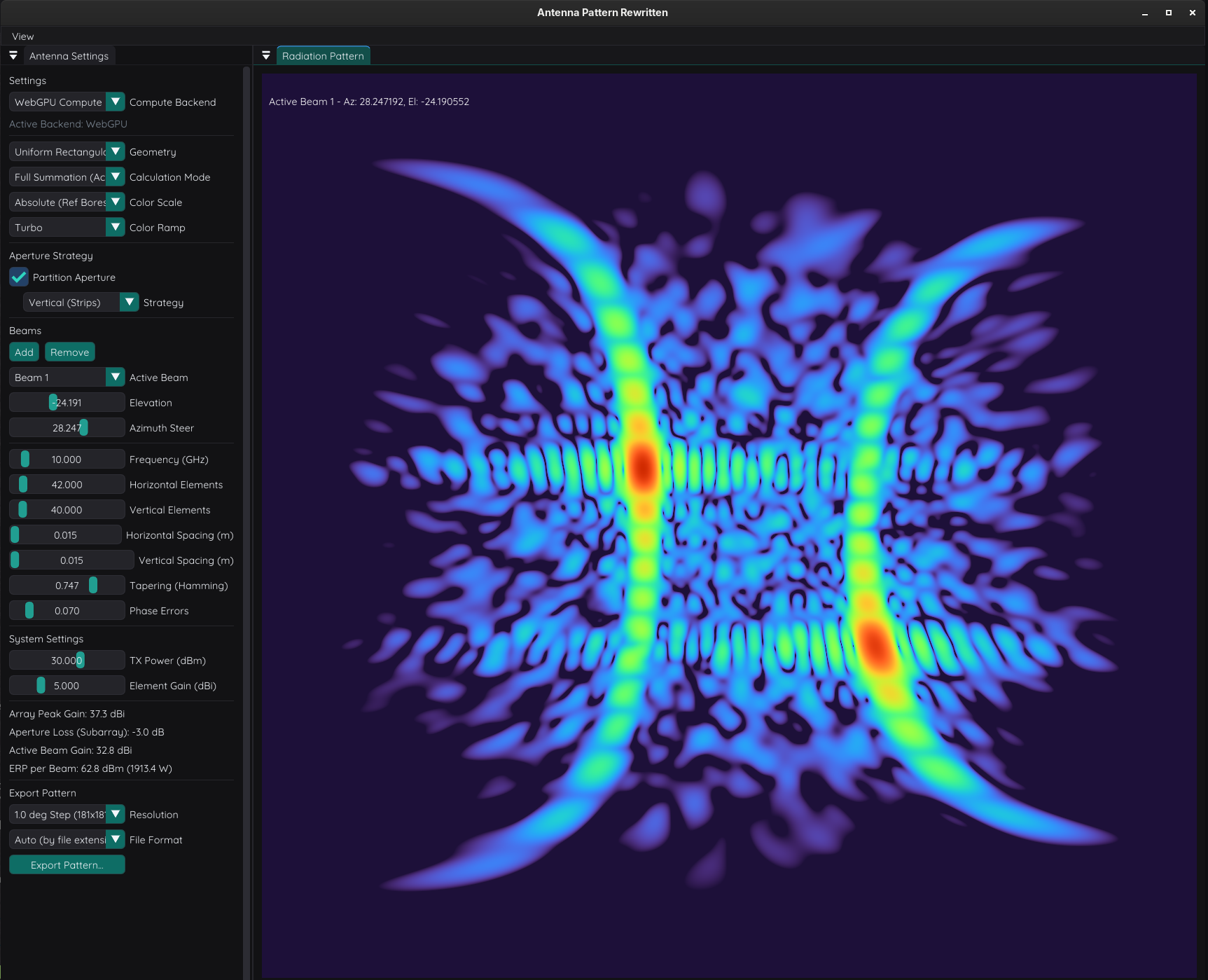
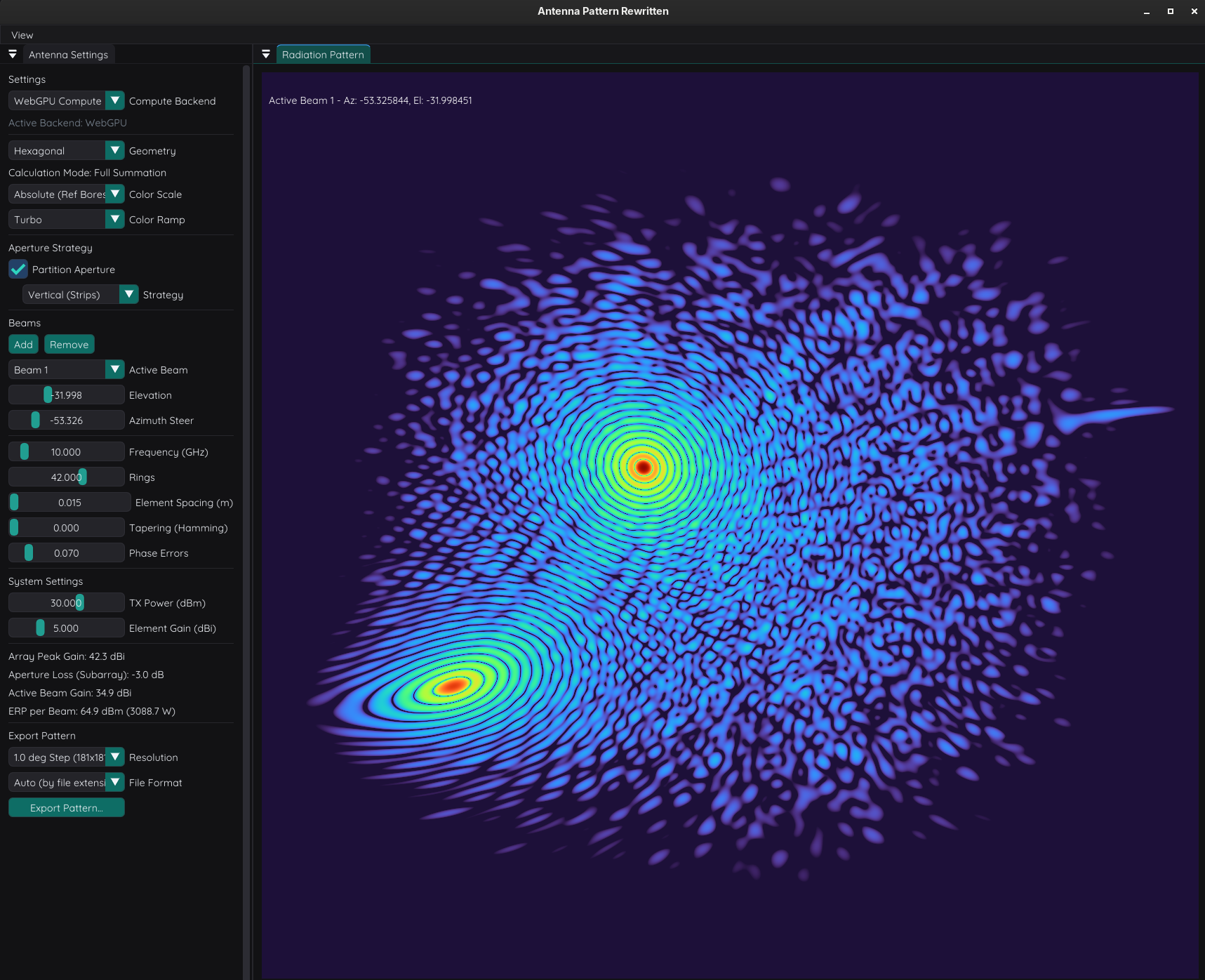
Complementing iqgen is the antenna simulation module, a GPU-accelerated phased array antenna modeling tool built on WGFX:
- Coherent Multi-Beam Summation: Simulates simultaneous steerable beams evaluating constructive and destructive electromagnetic wave interference (spatial fringes) across observation vectors in direction cosine (u, v) space.
- Aperture Partitioning & Subarrays:
- Overlapped: All elements participate in every beam with split element transmit power.
- Subarray Strips: Aperture is partitioned horizontally or vertically, widening beamwidth but concentrating power.
- Interleaved (Every N-th Element): Maintains full aperture sharpness while accurately introducing grating lobes.
- Array Geometries & Tapering:
- Grids: Uniform Rectangular Arrays (URA), concentric hexagonal rings, linear arrays, and sparse planar layouts.
- Analytical Radiators: Parabolic dish, horn, dipole, helical, patch, and corner reflector models.
- Tapering Windows: Hamming and Taylor amplitude weighting to minimize sidelobes.
- Scan Loss & Element Patterns: Realistic cosine rolloff (cos¹·⁵(θ)) with stochastic phase error perturbation.
- Dynamic Gain Coupling to
iqgen: Antenna radiation patterns exported fromantennafeed directly intoiqgen’s spatial link-budget pipeline, applying realistic directional gain based on real-time transmitter and receiver orientation.
Spectrum Visualizer & SigMF Recorder (waterfall)
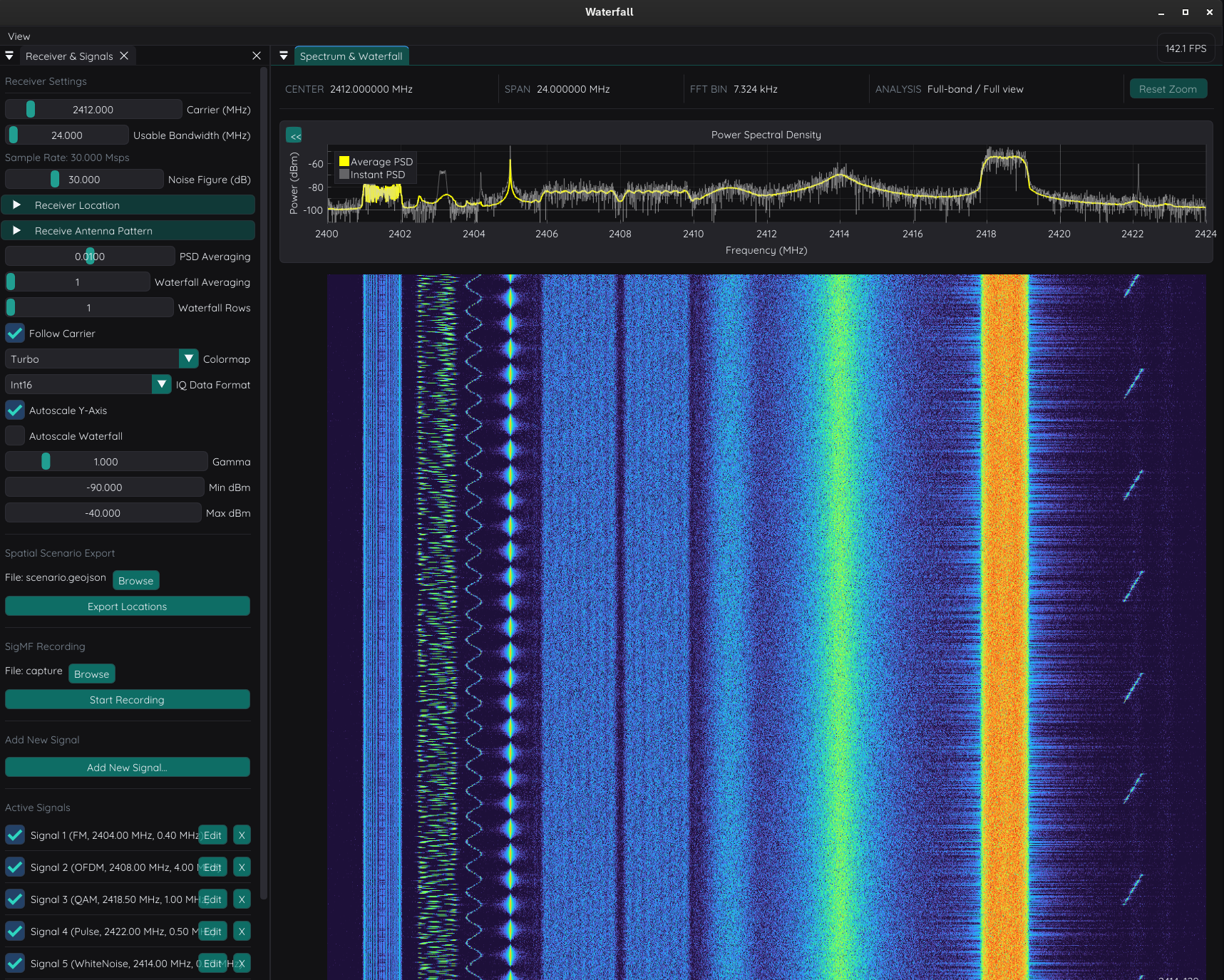
waterfall is a dedicated frontend receiving the VITA-49 stream, leveraging WGFX for GPU-accelerated visualization:
- Power Spectral Density (PSD): Real-time spectrum line plot with adjustable exponential moving average (EMA) smoothing, calibrated in dBm via ImPlot.
- Waterfall Spectrogram Heatmap: High-frame-rate time-history rendering powered by WebGPU compute shaders, featuring automatic dynamic range autoscaling and manual dBm floors.
- SigMF Recording: Records live RF captures directly to disk following the open SigMF standard, producing paired
.sigmf-databinary I/Q streams and.sigmf-metaJSON metadata.
2. backend + tracktor + trackfuse + tview: Kinematic Tracking & Multi-Sensor Fusion
graph LR
    subgraph S1 ["Sensor Modeling"]
        tracktor["tracktor
Kinematic Sensors
AESA / Surveillance Radar / IR / RF"]
    end

    subgraph S2 ["Correlation & Fusion"]
        trackfuse["trackfuse
Passive Bearing Triangulation
& Angular Kalman Filter"]
    end

    subgraph S3 ["Tactical Map"]
        tview["tview
2D/3D Situational Awareness Map
(144 FPS / WGFX)"]
    end

    tracktor ==>|"TTR1 Multicast (239.255.0.2:5000)
Raw Reports (Cartesian + LOBs)"| trackfuse
    tracktor -->|"Direct Diagnostic Display"| tview
    trackfuse ==>|"Fused 9D ECEF Tracks
(Position, Velocity, Accel)"| tview
Simulation Backend (src/satviz/backend)
The backend orchestrates the scenario’s physical ground truth:
- High-Resolution Scenario Clock: Deterministic fixed-step ticking maintaining millisecond time synchronization across distributed network processes.
- Mover Pipelines: Realistic waypoint and kinematic path models for commercial and military aircraft, surface naval vessels, and ground vehicles.
- DIS 7 State Dispatch: Translates internal truth states into IEEE 1278.1 Entity State PDUs, managing spatial coordinate transformations between WGS-84, ECEF, and local tangent frames (NED/ENU).
Kinematic Sensor Modeling (tracktor)
tracktor models active and passive sensors, generating realistic measurement vectors corrupted by physics-based noise:
- Sensor Modalities:
- AESA & Surveillance Radars: Models Active Electronically Scanned Arrays with agile beamforming, SNR-dependent detection probabilities, scan volume limits, Doppler range-rate, and rotating antenna mechanical timing.
- EO/IR Cameras: Optical cameras with contrast-based target detection and pixel centroid extraction.
- Passive RF Direction Finders: Intercepts emitter signals to produce high-accuracy angle-of-arrival (AoA) lines of bearing.
- 9D ECEF Kalman State Tracking: Range-capable sensors produce 9D kinematic state estimates in Earth-Centered, Earth-Fixed coordinates:
x = [x, y, z, ẋ, ẏ, ż, ẍ, ÿ, z̈]ᵀ(position, velocity, and acceleration vectors) along with fully populated 9×9 error covariance matrices. TTR1Multicast Protocol: Publishes standardized version-2 binary reports over the loopback multicast group (239.255.0.2:5000).
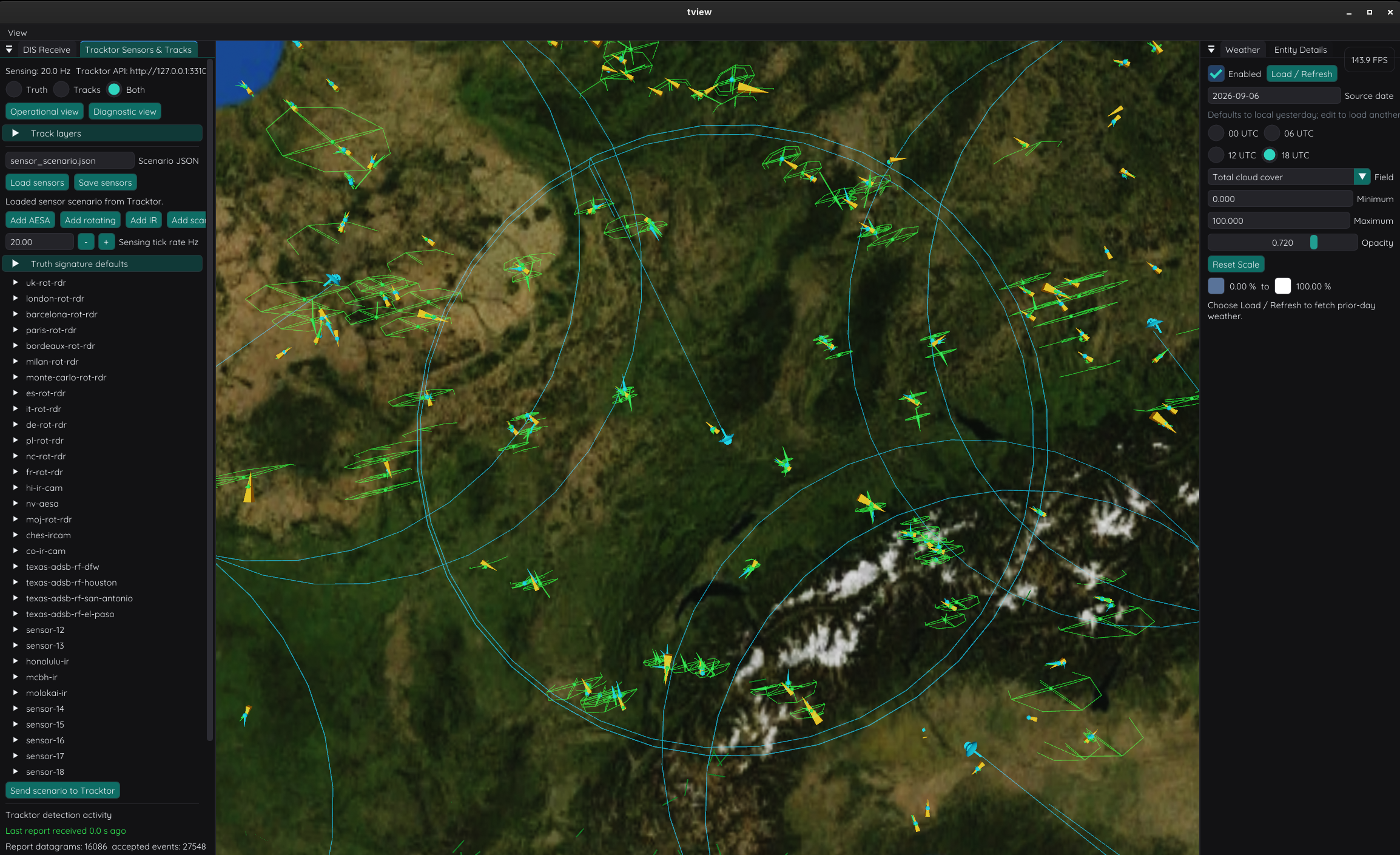
Multi-Sensor Data Fusion (trackfuse)
trackfuse is a standalone daemon that listens to the TTR1 report feed and resolves multi-sensor track association without “truth cheating”:
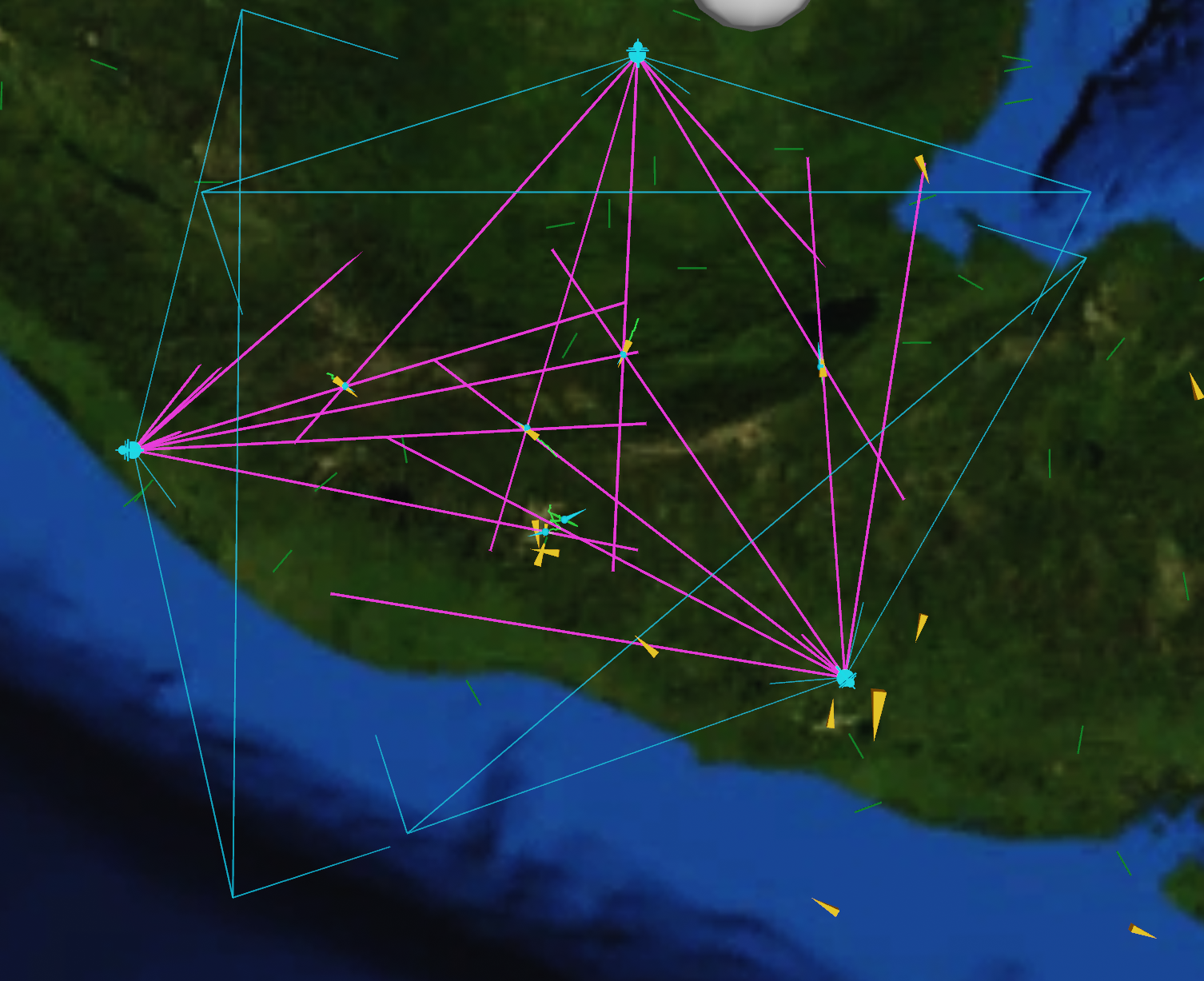
- Passive Line-of-Bearing Triangulation: Intersects contemporaneous bearing reports from disparate infrared cameras and passive RF sensors. It requires non-parallel line geometry and coherent support from at least two passive-RF or three IR sensors to eliminate false ghosts.
- Parallel Candidate Solving (Taskflow): Utilizes a Taskflow worker pool to unpack UDP packets, maintain prediction caches, and solve sparse candidate assignments in parallel using greedy cost ordering or bipartite minimum-cost matching.
- Covariance-Weighted Angular Kalman Filter: Once triangulated, subsequent lines of bearing apply angular innovation updates directly to the 9D ECEF covariance filter, establishing target velocity and acceleration over successive observation epochs.
- Loop-Free Re-broadcasting: Publishes fused Cartesian tracks back to
TTR1with unique track identifiers and loop-prevention guards.
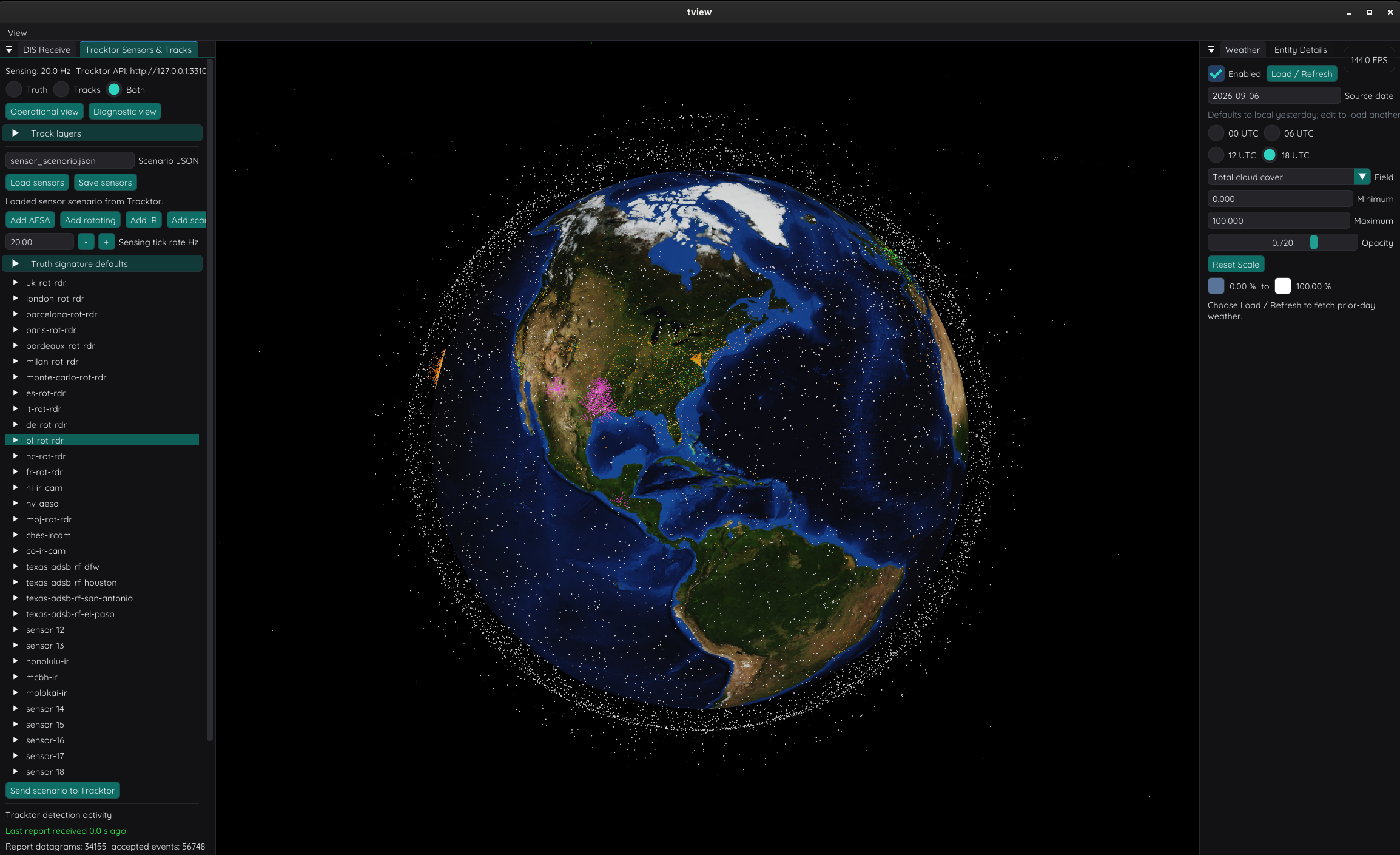
Tactical Situational Display (tview)
Built on WGFX using Dear ImGui and reactive rendering primitives, tview provides real-time situational awareness:
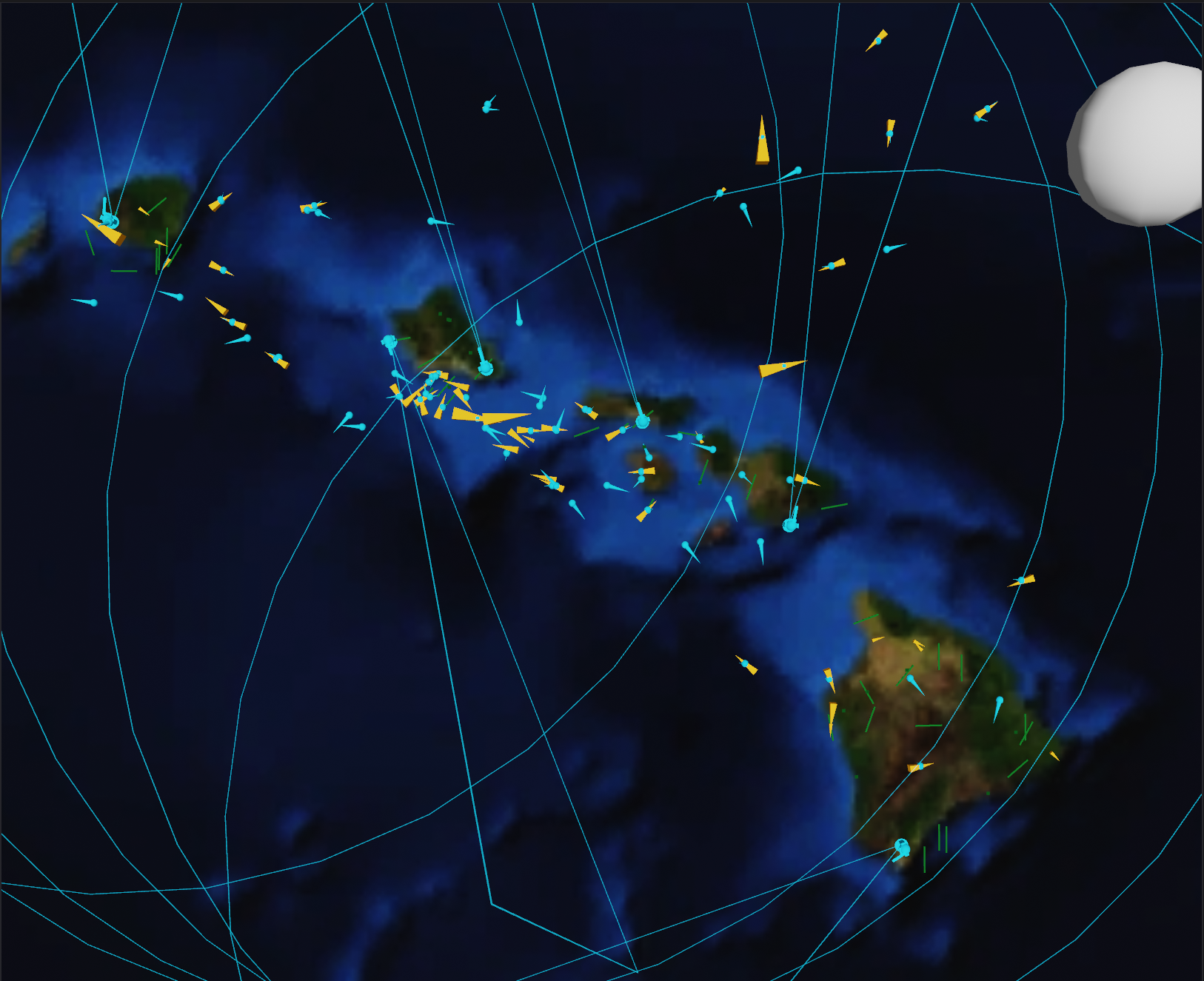
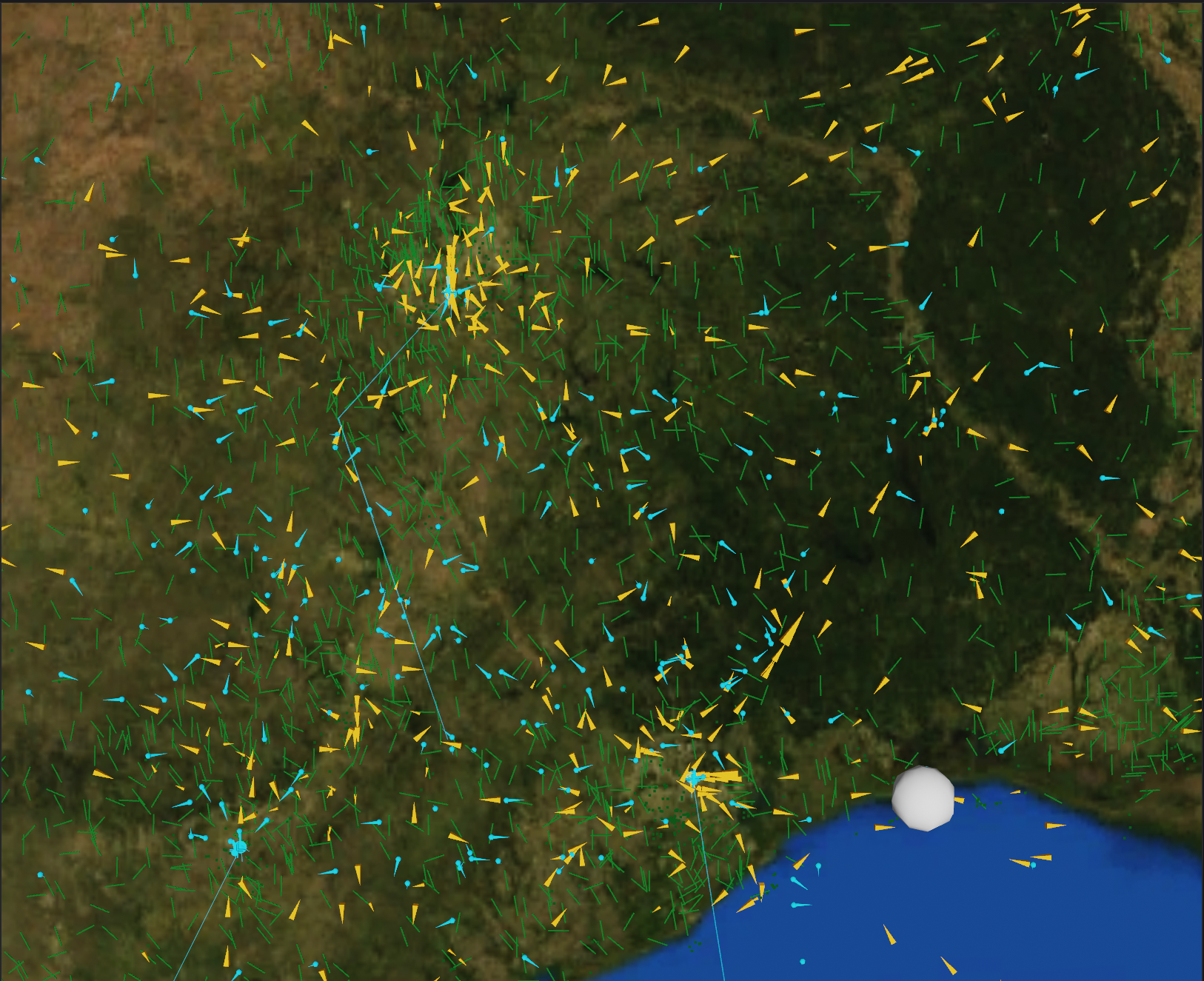
- Visualizes raw radar contacts, sensor field-of-regard coverage cones, active lines of bearing, kinematic uncertainty ellipses, and fused track histories on a responsive 2D/3D map.
- Real-time interaction with the
tracktorandtrackfusedaemons over HTTP REST APIs, allowing runtime parameter tuning, sensor injection, and scenario recording.
3. satviz + grayscale: Orbital Mechanics & Radiometric Imaging
Orbital Propagation & Constellation Visualization (satviz)
satviz simulates orbital space assets and evaluates cross-domain interactions with air and ground systems, rendering via WGFX:
- SGP4/SDP4 Ephemeris Propagation: Propagates satellite orbits in real time from Two-Line Element (TLE) catalogs, modeling atmospheric drag, Earth oblateness (J₂, J₃, J₄ zonal harmonics), and solar/lunar gravitational perturbations.
- Ground Track & Geometry Pipeline: Computes subsatellite ground tracks, orbital apogee/perigee, true anomaly, line-of-sight visibility cones, and ground-station elevation masks.
- Cross-Subsystem RF Link Geometry: Feeds satellite-to-ground slant ranges, look angles, and relativistic Doppler frequency shifts directly into
iqgenfor communication link modeling. - Constellation Mesh & Inter-Satellite Links (ISL): Models dynamic optical and RF inter-satellite links across dense LEO constellations, solving real-time end-to-end routing paths and communication latency between mobile ground, airborne, and space nodes.
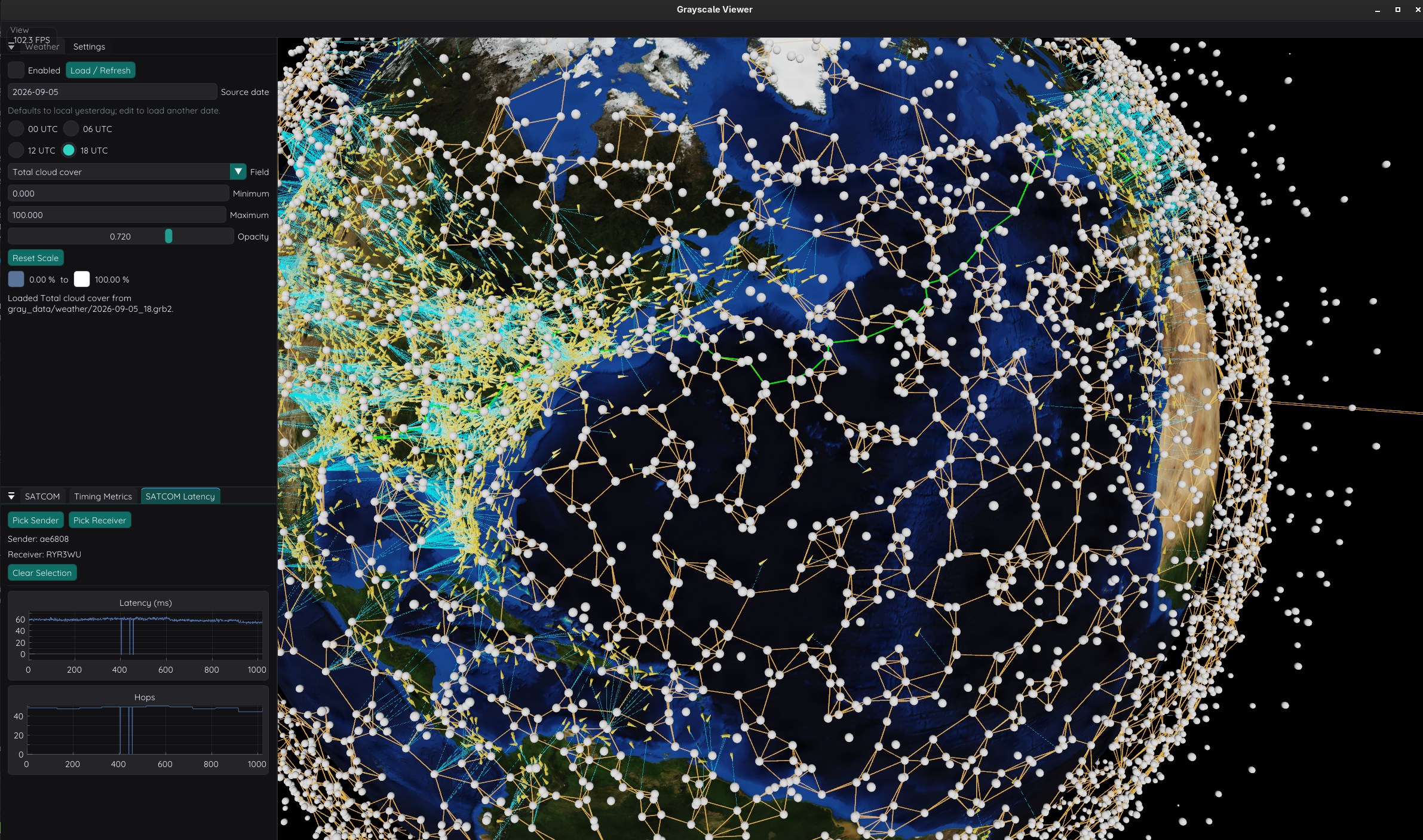
Synthetic EO/IR Sensor Imaging (grayscale)
The grayscale subsystem provides synthetic sensor video generation:
- Radiometric Sensor Pipeline: Simulates electro-optical and infrared (EO/IR) detectors across Mid-Wave (MWIR) and Long-Wave (LWIR) infrared spectral bands.
- Thermal Signature Rendering: Computes target thermal contrast against ambient terrestrial and cloud backgrounds in calibrated monochrome grayscale.
- Frustum & Occlusion Culling: Fast spatial bounding-sphere culling determining target visibility within narrow optical sensor fields of view.
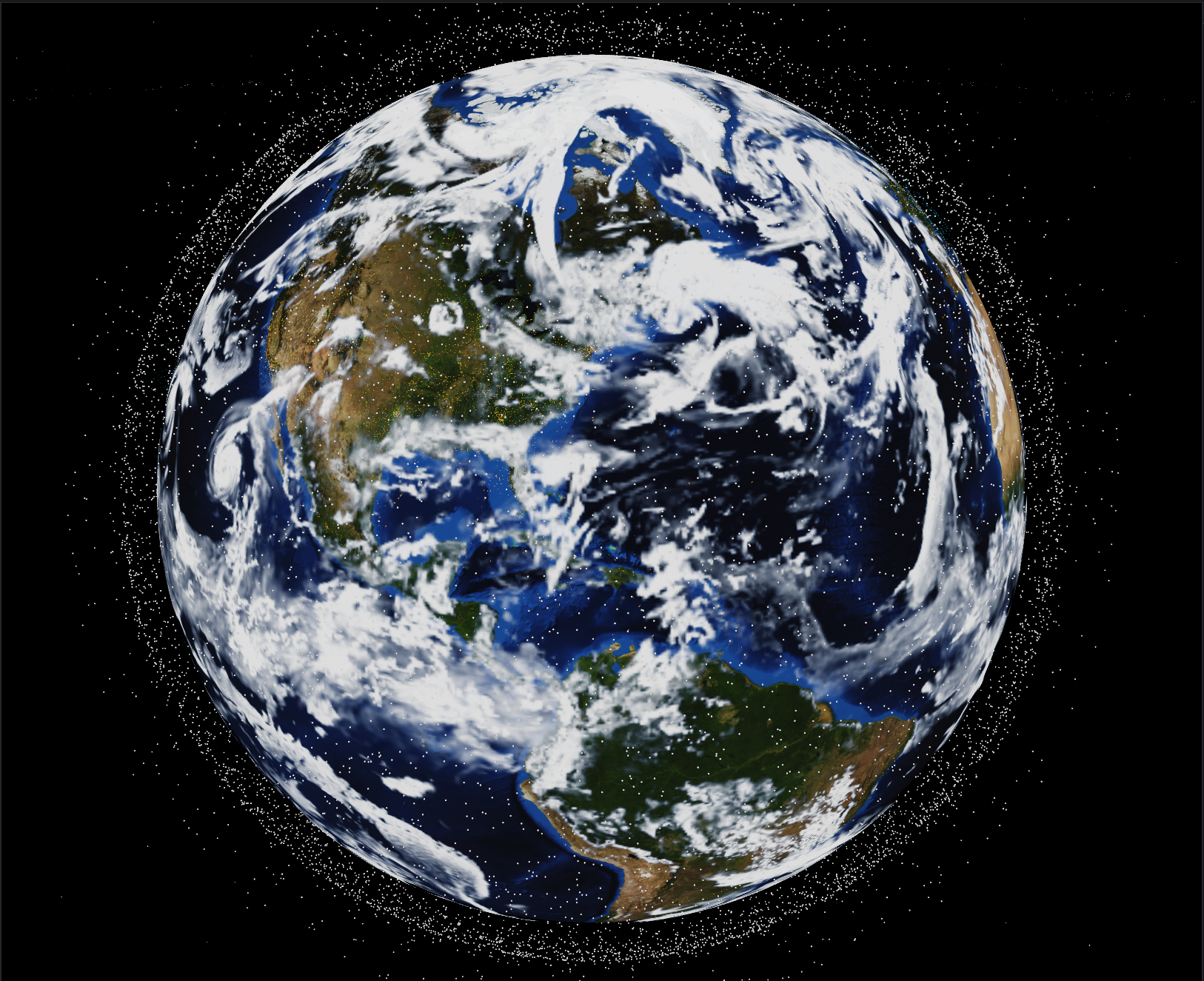
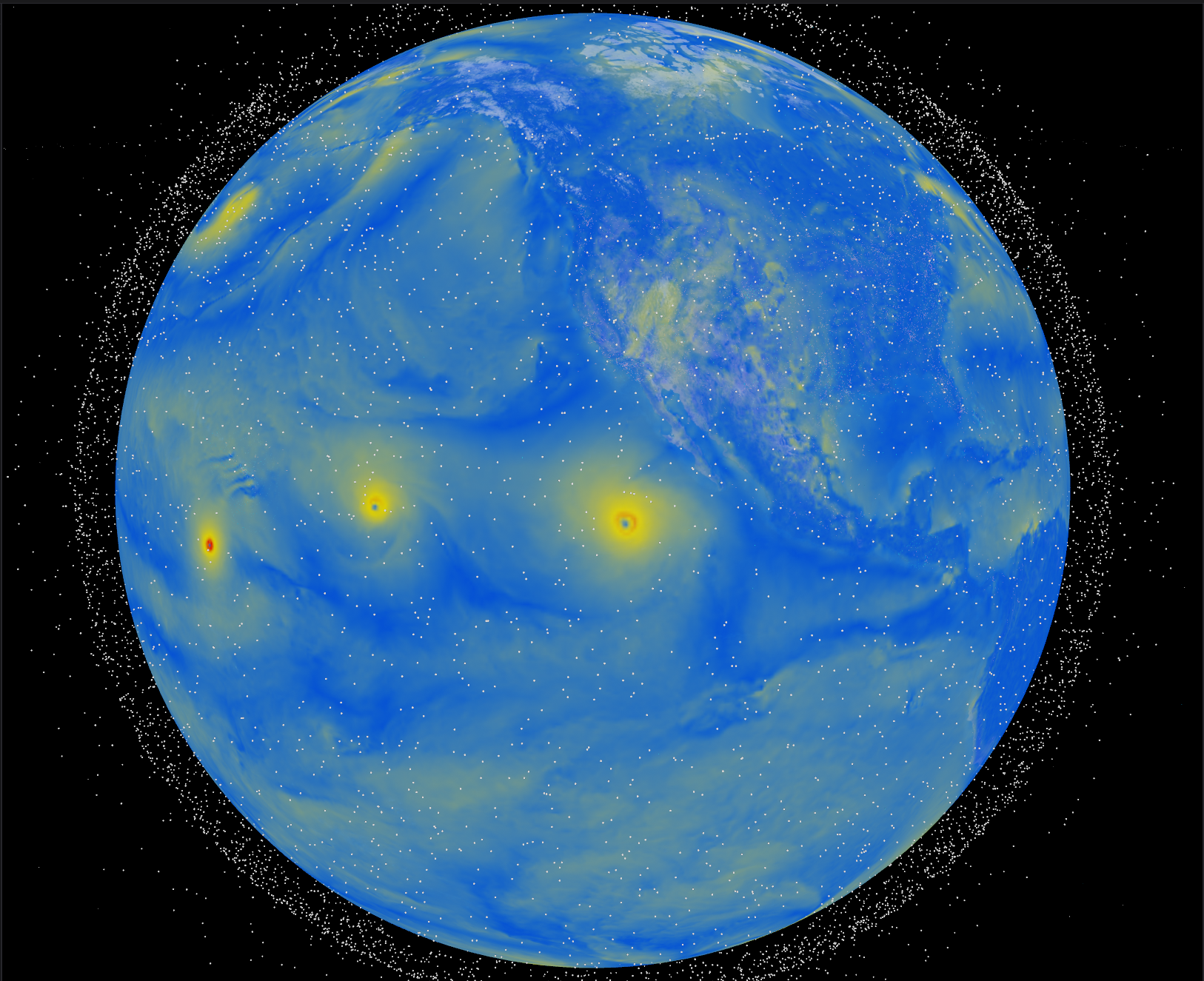
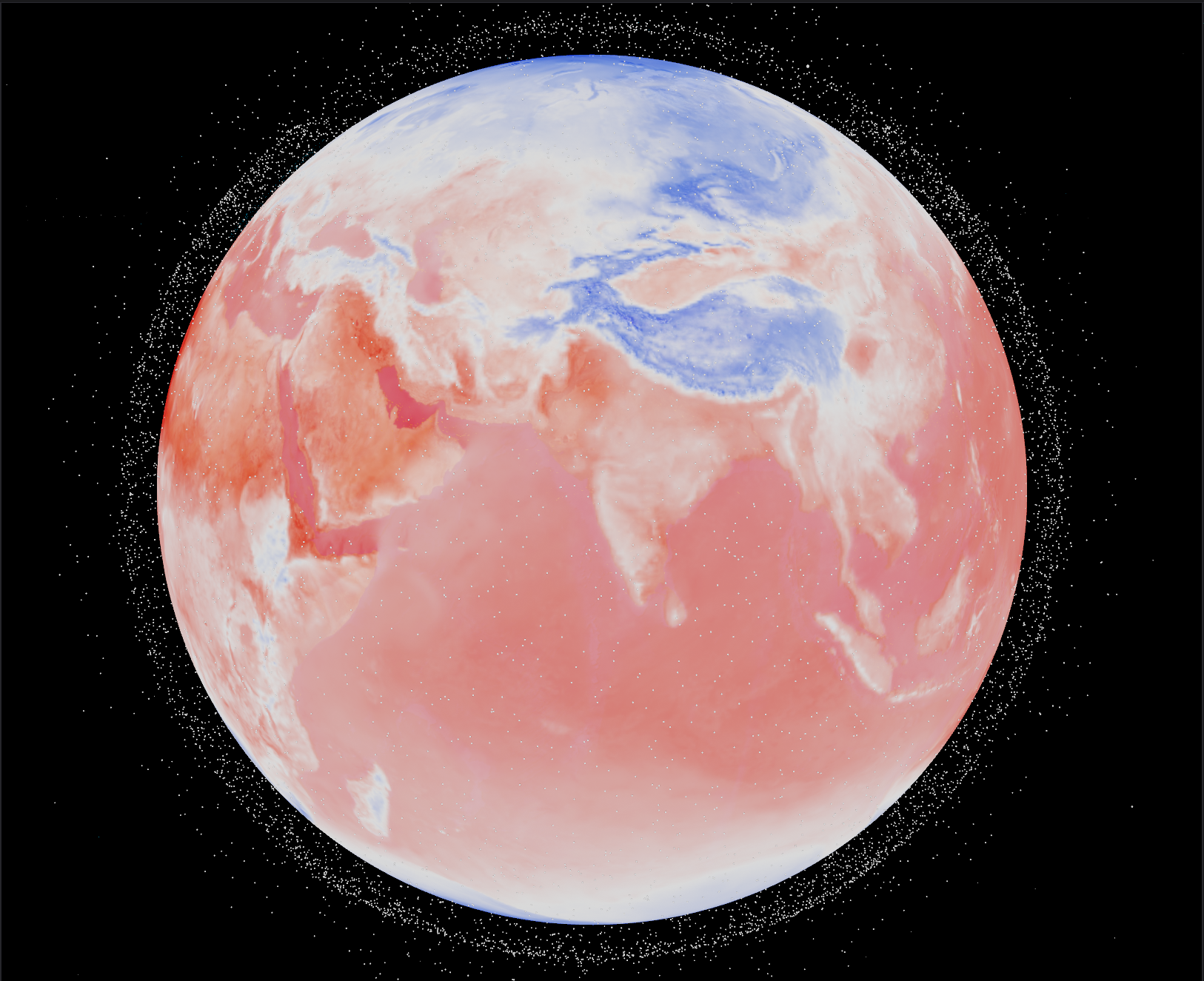
Real-Time GRIB2 Environmental & Weather Pipeline
tsim integrates high-resolution NOAA GRIB2 atmospheric forecast datasets into the 3D globe rendering engine, modulating optical sensor attenuation, RF atmospheric absorption, and cloud occlusion:
4. disrupt: Modern IEEE 1278.1 / DIS 7 Protocol Engine
At the core of tsim’s network interoperability is disrupt, a modern C++20 implementation of the IEEE 1278.1-2012 (DIS 7) standard:
- Entity-Component Architecture: Built around EnTT for high cache locality during large-scale simulation ticks.
- Automated Dead-Reckoning: Computes DRM algorithms (FPW, RPW, RVW, FVW) and automatically issues Entity State PDUs when kinematic deviation thresholds or heartbeat timers expire.
- Zero-Fragmentation PDU Bundling: Concatenates multiple PDUs produced during the same simulation step into single UDP datagrams up to the network MTU, slashing socket kernel transitions and packet fragmentation.
- Comprehensive Protocol Support: Implements over 20 PDU types including Entity State, Fire, Detonation, Collision, Electromagnetic Emission (EE), IFF/ATC/NAVAIDS, Transmitter/Receiver/Signal, and Simulation Management.
- Asynchronous Networking: Uses Asio for non-blocking UDP I/O with pluggable deterministic in-memory sinks for automated CI testing.
Full Tech Stack & Dependencies
- Graphics & Compute Engine: WGFX (WebGPU / Google Dawn / C++20)
- Language: Modern C++20
- Simulation Standards: IEEE 1278.1-2012 (DIS 7), VITA-49.0 (VRT), SigMF
- Compute & Graphics: WebGPU (Dawn), WGSL Shaders, CUDA, ROCm/HIP, Dear ImGui, ImPlot
- Math & Kinematics: GLM, SGP4, Kalman Filters (9D ECEF with 9×9 Covariance Matrices)
- Concurrency & ECS: Taskflow, EnTT
- Networking & I/O: Asio (UDP Multicast & Unicast), WebSockets, HTTP REST API
- Audio DSP: miniaudio
- Build System: Modern CMake with CPM.cmake & vcpkg